When you are building a house or any structure, the foundation is not just the starting point. It is the backbone of everything that stands above it. A poorly designed foundation can lead to cracks, uneven settlement, and in the worst cases, complete structural failure. Among the many types of foundations used in modern construction, eccentric footing is one that often gets overlooked, yet plays a vital role in urban and boundary construction scenarios.
In this comprehensive guide, you will learn everything about eccentric footing including its meaning, design steps, key formulas, reinforcement details, and a practical numerical example.
Table of Contents
ToggleWhat is Eccentric Footing?
In a standard footing, the column sits right at the center of the base, and the load travels straight down through the middle. This creates uniform pressure on the soil beneath. Eccentric footing works differently.
Eccentric footing is a type of foundation where the column is NOT placed at the center. Instead, the column is positioned near one edge of the footing, causing the load to act off-center. This off-center positioning is what engineers call eccentricity.
What Eccentricity Causes
Because the load is not centered, three main problems arise:
- Unequal soil pressure beneath the footing
- A bending moment that would not exist in a centered design
- Additional tension and compression forces within the concrete
Why is Eccentric Footing Used?
You might wonder why anyone would design a footing this way. The answer is simple: sometimes the construction site leaves no other choice.
Common Situations Where It is Required
Boundary Columns: When a column sits right at the property line and the footing cannot extend beyond it, eccentric footing becomes the only option.
Limited Space Conditions: When extending the footing equally on both sides is physically impossible due to site restrictions.
Adjacent Building Constraints: When a neighboring building is right next to your plot and the new footing cannot disturb the existing structure.
Road-Side Columns: Columns near public roads or footpaths cannot project outward because of civic regulations and right-of-way restrictions.
In densely built cities, boundary columns are extremely common on residential and commercial plots. Builders and structural engineers working in such areas regularly rely on eccentric footings as a practical, real-world solution.
Types of Eccentric Footing
There are three main types used in construction practice.
1. Isolated Eccentric Footing
This supports a single column with an off-center load. It is the simplest form and most commonly used when only one column is affected by boundary conditions.
2. Combined Footing (Eccentric Type)
Here, two columns are supported by a single footing. The footing is carefully sized so that the resultant load acts as close to the center of the base as possible, keeping soil pressure as uniform as the conditions allow.
3. Strap Footing
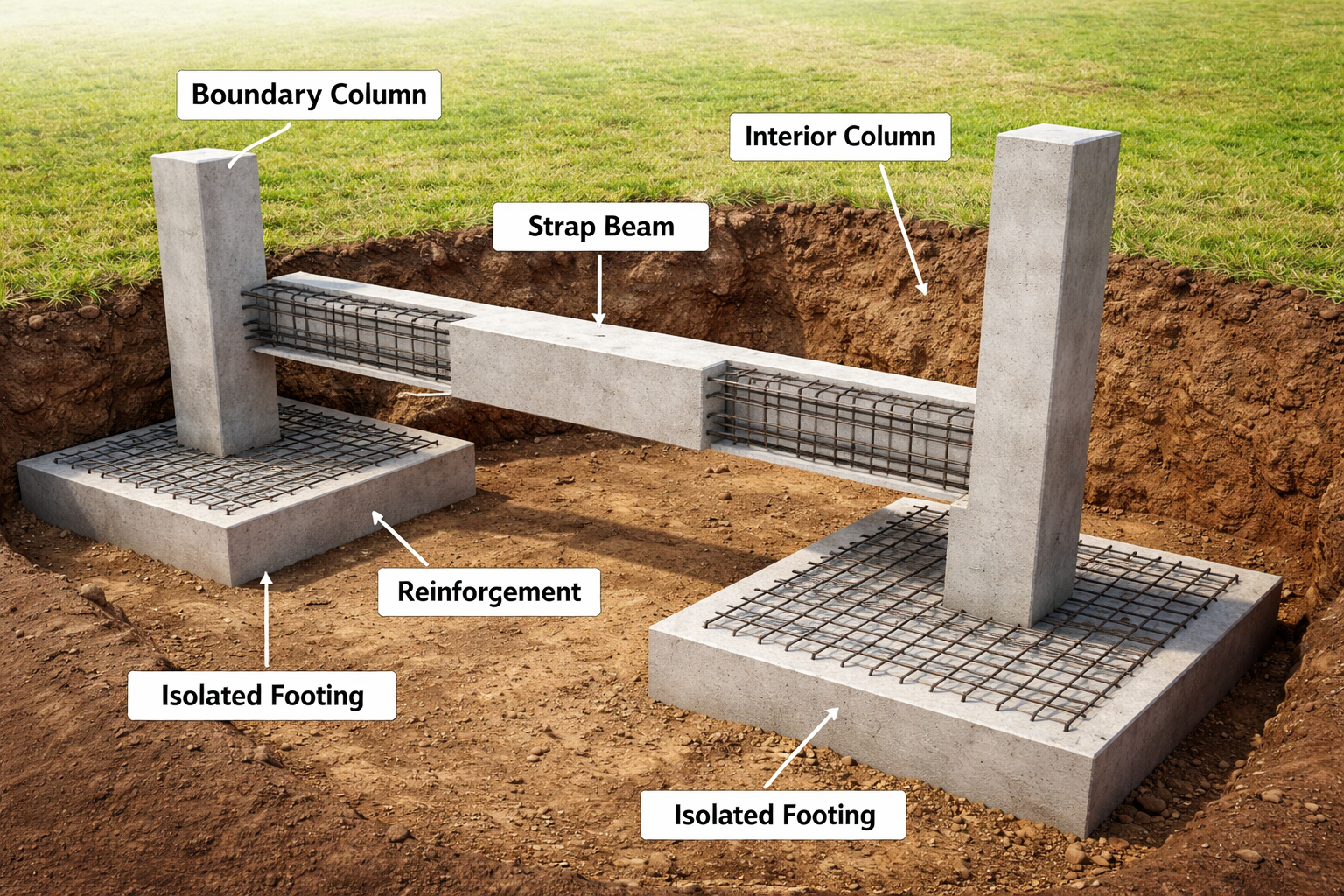
In this type, two isolated footings are connected by a reinforced concrete strap beam. The strap beam transfers the eccentric moment from the boundary column footing to the interior column footing, effectively balancing the system and reducing the negative effects of eccentricity.
Eccentric Footing Design: Step by Step
Designing an eccentric footing requires a careful and methodical approach because the soil pressure is non-uniform and the footing must handle bending forces in addition to direct compression.
Step 1: Calculate the Total Load (P)
The total vertical load acting on the footing is the sum of three components: the column load, the self-weight of the footing, and any wall load being transferred through the column.
Step 2: Calculate the Eccentricity (e)
Eccentricity is calculated using this formula:
e = M / P
Where M is the bending moment caused by the off-center load and P is the total vertical load. This value tells you exactly how far off-center the resultant load is acting on the footing base.
Step 3: Check the Soil Pressure
This is the most critical step. Because the load is off-center, one edge of the footing pushes harder into the soil than the other. The maximum and minimum soil pressures are calculated using:
q max = (P / A) x (1 + 6e / B)
q min = (P / A) x (1 – 6e / B)
Where A is the area of the footing and B is the width of the footing in the direction of eccentricity.
The Most Important Condition in Eccentric Footing
e must be less than or equal to B / 6
This is a rule that must never be violated. If the eccentricity exceeds B/6, tension will develop in the soil beneath the footing. Since soil cannot resist tension, this leads to the footing lifting off on one side, causing dangerous instability. A safe design always ensures that q min remains a positive (compressive) value.
Step 4: Design for Bending Moment
The maximum bending moment in the footing occurs at the face of the column. It is calculated as:
M = q x L² / 2
Once the bending moment is known, steel reinforcement is calculated using standard RCC design principles as per IS 456 guidelines.
Eccentric Footing Formula Summary
Here is a quick reference for all the key formulas:
| Formula | Expression |
|---|---|
| Eccentricity | e = M / P |
| Maximum Soil Pressure | q max = (P/A)(1 + 6e/B) |
| Minimum Soil Pressure | q min = (P/A)(1 – 6e/B) |
| Safe Condition | e must be less than or equal to B/6 |
| Bending Moment | M = q x L² / 2 |
Mastering these formulas is essential for anyone involved in foundation design or structural engineering.
Eccentric Footing Reinforcement
Because the load is off-center, the reinforcement in an eccentric footing is not symmetrical like in a standard footing. It must be carefully detailed to handle unequal forces.
Key Reinforcement Principles
More Steel on the Tension Side: The side of the footing where soil pressure is lower experiences more tension. Extra steel bars must be provided on this side to handle the tensile forces that concrete alone cannot resist.
Bottom Reinforcement: The main reinforcing steel is placed at the bottom of the footing. This is the primary tension zone in most loading conditions.
Top Reinforcement: When bending reversal occurs due to the eccentric loading pattern, top reinforcement must also be provided to prevent cracking from the upper face.
Development Length: All reinforcing bars must be extended beyond the critical section by the required development length to ensure proper anchorage and load transfer.
Minimum Reinforcement: As per IS 456, a minimum reinforcement of 0.12% to 0.15% of the cross-sectional area must always be maintained, even if calculations suggest less is needed.
Practical Reinforcement Tips
- Use high yield strength deformed bars, commonly Fe500 grade
- Maintain a minimum concrete cover of 50 mm in footings to protect steel from moisture and corrosion
- Provide extra bars near the column face to handle increased shear and bending at that critical zone
Practical Numerical Example
Let us now apply everything we have learned to a real calculation.
Given Data
- Column Load (P) = 1000 kN
- Footing Size = 2m x 2m
- Eccentricity (e) = 0.2 m
Step 1: Calculate Area
A = 2 x 2 = 4 m²
Step 2: Calculate Average Soil Pressure
P / A = 1000 / 4 = 250 kN/m²
Step 3: Calculate Maximum Soil Pressure
q max = 250 x (1 + 6 x 0.2 / 2) q max = 250 x (1 + 0.6) q max = 250 x 1.6 q max = 400 kN/m²
Step 4: Calculate Minimum Soil Pressure
q min = 250 x (1 – 0.6) q min = 250 x 0.4 q min = 100 kN/m²
Result
Since q min = 100 kN/m², which is positive, no tension has developed in the soil. The design is safe and acceptable. If q min had come out negative, the eccentricity would need to be reduced or the footing size increased.
Advantages of Eccentric Footing
- Perfectly suited for boundary and property-line columns
- More economical than combined footing in many cases
- Saves valuable space on tight urban plots
- Practical and effective for city construction conditions
Disadvantages of Eccentric Footing
- Creates unequal soil pressure that demands more careful analysis
- Introduces higher bending moments compared to a centered footing
- Requires experienced structural engineers for safe design
- Not suitable for weak or low-bearing-capacity soils
Eccentric Footing vs Concentric Footing
| Feature | Concentric Footing | Eccentric Footing |
|---|---|---|
| Column Position | Center | Off-center |
| Soil Pressure | Uniform | Non-uniform |
| Bending Moment | Low | High |
| Design Complexity | Simple | Complex |
When Should You Avoid Eccentric Footing?
There are situations where eccentric footing is not the right choice and should be replaced with a combined footing or raft foundation.
Avoid eccentric footing when the soil bearing capacity is very low, as the concentrated pressure on one edge can cause differential settlement. Also avoid it when the eccentricity value is very high, because controlling soil pressure and bending moments becomes extremely difficult. For heavy multi-storey buildings, the forces involved are too large for a simple eccentric footing to handle safely.
Practical Construction Tips
Before and during construction, keep these points in mind:
- Always conduct a soil test before finalizing the footing type and size
- Ensure proper soil compaction below the footing base
- Use a concrete mix of M20 grade or above for structural footings
- Never ignore reinforcement detailing, especially near the column face and tension side
- Always hire an experienced structural designer for eccentric footing projects
Ignoring any of these steps can result in cracks in walls, differential settlement of the structure, and long-term structural instability that is expensive and dangerous to fix.
Conclusion
Eccentric footing is a specialized but essential type of foundation used when a column cannot be centered over its base due to site constraints. It introduces unique challenges including non-uniform soil pressure, higher bending moments, and asymmetric reinforcement requirements.
The three things to always remember are that eccentricity must stay within B/6, soil pressure must always remain compressive with no tension, and reinforcement must be heavier on the tension side. When these rules are followed and proper structural calculations are carried out, eccentric footing performs safely and economically even in the most challenging urban construction environments.
Foundation design is never an area where shortcuts should be taken. A small mistake at the base of a building can lead to consequences that affect the entire structure for decades to come.
Need Safe and Accurate Foundation Design for Your Home?
Foundation mistakes can lead to cracks, uneven settlement, and long-term structural problems. Whether you are building a boundary column, duplex house, or multi-storey home, proper footing design is critical.
At SmartScale House Design, we provide:
-
Structural footing design with detailed calculations
-
Eccentric, combined, and raft foundation design
-
RCC reinforcement detailing drawings
-
Soil-based safe bearing capacity planning
-
Complete 2D & 3D house design services
-
Online architect consultation across India
Our expert structural team ensures your foundation is safe, economical, and built to last.
Contact SmartScale House Design today for professional foundation and house planning support.