
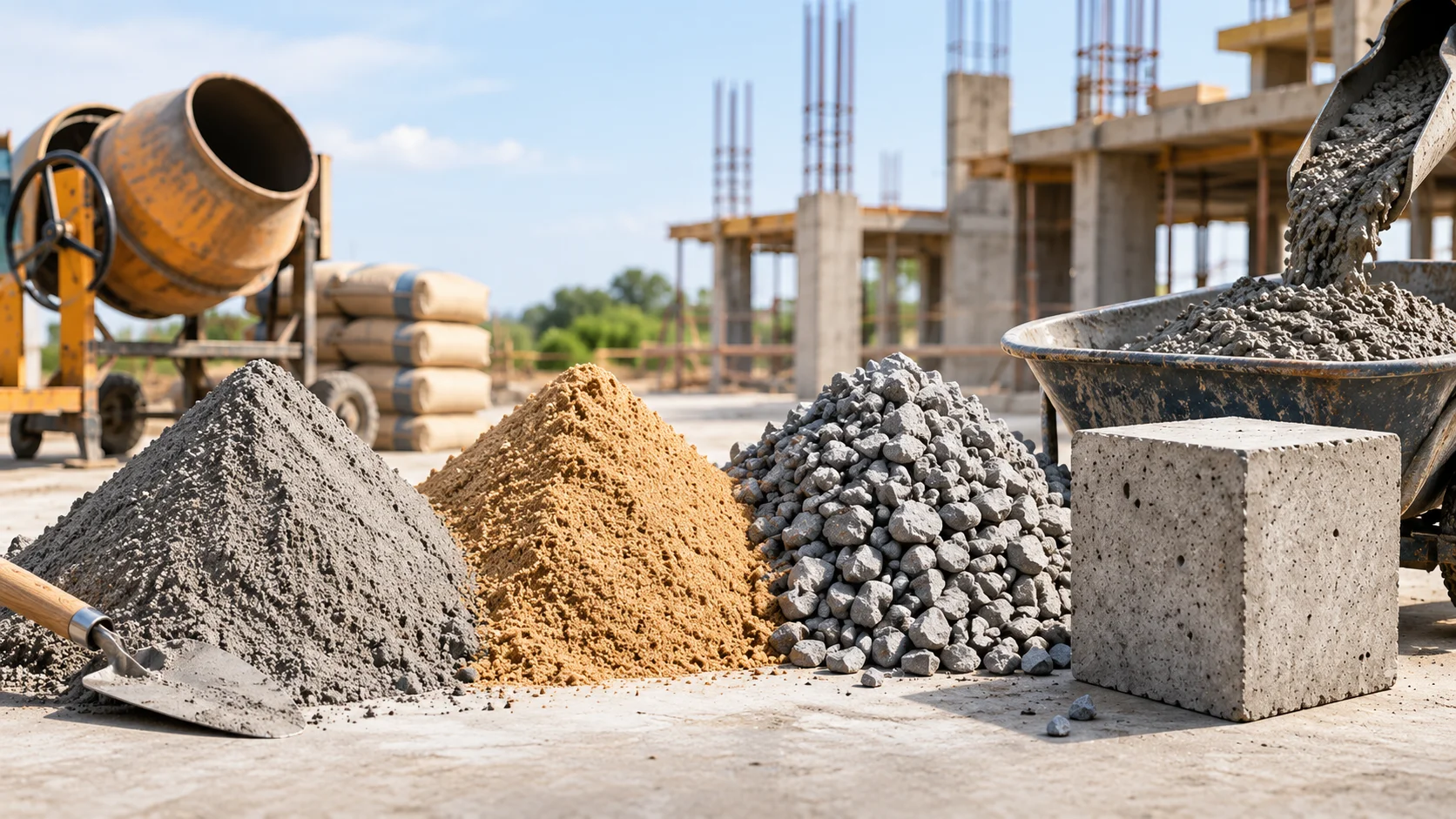
M30 concrete is a commonly specified grade of concrete for structural construction where higher strength and durability are required. It is used in reinforced concrete slabs, beams, columns, foundations and other structural members, depending on the structural design.
One of the most common questions during construction is: What is the M30 concrete ratio?
Unlike lower grades such as M20, M30 is generally treated as a design mix rather than a fixed nominal mix. Therefore, there is no single cement:sand ratio that can be applied to every M30 concrete project. The mix is proportioned using the required strength, workability, exposure condition, aggregate characteristics, water-cement ratio, cementitious materials and admixtures.
According to the principles of Indian concrete mix design, M30 concrete is proportioned to achieve a characteristic compressive strength of 30 N/mm² at 28 days. IS 10262 provides guidelines for concrete mix proportioning, while IS 456 provides requirements related to structural concrete, durability and water-cement ratio.
Table of Contents
ToggleWhat Is M30 Concrete?
M30 is a grade designation for concrete.
The letter M represents the concrete mix, while the number 30 represents the specified characteristic compressive strength of concrete at 28 days.
Therefore:
M30 concrete = 30 N/mm² characteristic compressive strength at 28 days
This strength is normally determined through compressive strength testing of standard concrete specimens.
It is important to understand that 30 N/mm² is the specified characteristic strength and not necessarily the exact average strength obtained from every batch. Mix design targets an appropriate higher mean strength to account for normal variations in materials, batching, mixing, placing and testing.
M30 Concrete Ratio: Quick Answer
There is no universal fixed M30 concrete ratio such as 1:1:2 that can be used for all projects.
M30 is a design mix. A typical example of a designed M30 mix may contain approximately:
| Material | Example quantity per 1 m³ |
|---|---|
| Cement | 380 kg |
| Water | 160–165 litres |
| Fine aggregate/sand | Around 700–730 kg |
| Coarse aggregate | Around 1,180–1,280 kg |
| Chemical admixture | Depending on mix design |
| Water-cement ratio | Around 0.42–0.44 in many example designs |
These figures are illustrative, not a universal M30 recipe. Published M30 design examples show different quantities because the final mix depends on aggregate grading, specific gravity, moisture, required slump, cement type, admixture and other project conditions.
For example, one M30 design worked under IS 10262:2009 used 380 kg cement, 160 litres water, 711 kg fine aggregate and 1,283 kg coarse aggregate per cubic metre, with a water-cement ratio of 0.42.
This is why copying a ratio from another project is not a substitute for an approved mix design.
M30 Concrete Mix Ratio Table
For quick reference, an example M30 design mix can be represented as follows:
| Parameter | Example M30 mix |
|---|---|
| Concrete grade | M30 |
| Characteristic strength at 28 days | 30 N/mm² |
| Cement | 380 kg/m³ |
| Water | 160 litres/m³ |
| Fine aggregate | 711 kg/m³ |
| Coarse aggregate | 1,283 kg/m³ |
| Water-cement ratio | 0.42 |
| Coarse aggregate | 20 mm + 10 mm fractions |
| Admixture | About 1.9 kg/m³ in the cited example |
The above values come from a specific worked M30 mix design and should not be treated as the mandatory composition for every construction project.
A more recent worked example based on IS 10262:2019 uses a different combination of cement, water, fine aggregate and coarse aggregate, again demonstrating why there is no single universal M30 ratio.
Is There a Fixed M30 Concrete Ratio?
No.
This is one of the most important points to understand before calculating M30 concrete quantities.
For some lower concrete grades, people commonly use nominal proportions such as:
- M10 = 1:3:6
- M15 = 1:2:4
- M20 = 1:1.5:3
However, M30 is normally produced using a design mix rather than relying on a fixed nominal proportion.
A design mix determines the quantities of cementitious material, water, fine aggregate, coarse aggregate and admixtures based on the actual materials and required performance.
For example, two M30 mixes may have:
- Different cement contents
- Different sand quantities
- Different coarse aggregate quantities
- Different water contents
- Different water-cement ratios
- Different admixture dosages
Both can still be designed to achieve the specified M30 performance.
Therefore, saying that the M30 ratio is always 1:1:2 or another fixed proportion is misleading.
M30 Concrete Ratio Formula
The basic concept behind concrete mix proportioning is to determine the quantities of each ingredient required to produce the desired concrete properties.
A simplified relationship for the water-cement ratio is:
Water-Cement Ratio = Weight of Water / Weight of Cement
Therefore:
Cement Quantity = Water Quantity ÷ Water-Cement Ratio
For example, if a particular design requires:
- Water = 160 litres
- Water-cement ratio = 0.42
Then:
Cement = 160 ÷ 0.42
Cement ≈ 381 kg/m³
A worked M30 design gives approximately 380 kg/m³ cement using 160 litres of water and a 0.42 water-cement ratio.
However, this is only one part of the mix design. The quantities of fine and coarse aggregates are calculated using the absolute-volume method and other requirements of the applicable standard.
How M30 Concrete Mix Design Is Calculated
M30 mix design involves several steps rather than simply selecting a cement:sand ratio.
1. Select the Concrete Grade
The first step is to establish the required grade.
For M30:
Characteristic compressive strength = 30 N/mm² at 28 days
The mix must be proportioned to provide the required characteristic strength while also satisfying workability and durability requirements.
2. Determine the Target Mean Strength
The mix is not simply designed to average exactly 30 N/mm².
A higher target mean strength is generally selected to account for variations in concrete production.
A commonly used relationship in mix design is:
Target mean strength = Characteristic strength + 1.65 × standard deviation
For example, if the characteristic strength is 30 N/mm² and an applicable standard deviation of 5 N/mm² is used:
Target mean strength = 30 + (1.65 × 5)
Target mean strength = 38.25 N/mm²
A worked M30 example based on IS 10262:2009 uses this approach.
The actual standard deviation adopted should be based on the applicable code provisions and available quality-control data.
3. Select the Water-Cement Ratio
The water-cement ratio has a major influence on the strength and durability of concrete.
The formula is:
W/C ratio = Weight of water ÷ Weight of cement
For example:
If water = 160 kg/m³
and cement = 380 kg/m³
Then:
W/C = 160 ÷ 380
W/C ≈ 0.42
The selected water-cement ratio must satisfy both strength requirements and the durability requirements applicable to the exposure condition.
IS 456 specifies a maximum water-cement ratio for different exposure conditions. A commonly cited value for M30 under certain exposure requirements is 0.45, but the applicable exposure condition must be checked rather than assuming the same value for every project.
4. Determine Water Content
Water content depends on several factors, including:
- Maximum aggregate size
- Required slump
- Aggregate shape
- Aggregate grading
- Admixture use
- Required workability
For example, one M30 design calculated water content of 160 litres/m³ for its specified conditions and used a superplasticizer.
Another worked M30 example used different water requirements because its workability and mix conditions were different.
This demonstrates why the water quantity should not simply be copied from another M30 mix.
5. Calculate Cement Content
Once the water content and water-cement ratio have been established:
Cement = Water ÷ Water-Cement Ratio
For example:
Water = 160 litres/m³
W/C ratio = 0.42
Therefore:
Cement = 160 ÷ 0.42
Cement ≈ 381 kg/m³
Rounded for batching, this can be approximately 380 kg/m³.
The calculated cement content must also satisfy the minimum cement content and durability requirements applicable to the project.
6. Determine Fine and Coarse Aggregate
The remaining concrete volume is occupied primarily by aggregates.
The absolute-volume method considers the volume occupied by:
- Cement
- Water
- Admixture
- Fine aggregate
- Coarse aggregate
- Entrapped or entrained air, where applicable
The basic concept is:
Volume of aggregates = 1 m³ − volume of cement − volume of water − volume of admixture − volume of air
The aggregate volume is then divided into fine and coarse aggregate according to the applicable mix design procedure.
One worked M30 design used 62% coarse aggregate and 38% fine aggregate by aggregate volume under its specified conditions.
The actual percentage can change based on aggregate size, sand grading, water-cement ratio and other factors.
M30 Concrete Ratio of Cement, Sand and Aggregate
Because M30 is a design mix, it is better to express the mix in kg/m³ rather than presenting one fixed nominal ratio.
For example, consider the following illustrative M30 mix:
- Cement = 380 kg
- Fine aggregate = 711 kg
- Coarse aggregate = 1,283 kg
The approximate mass proportions relative to cement are:
Cement : Fine Aggregate : Coarse Aggregate
380 : 711 : 1283
Dividing each quantity by 380 gives approximately:
1 : 1.87 : 3.38
Therefore, this particular example can be expressed approximately as:
M30 ratio ≈ 1 : 1.87 : 3.38
But this should not be published or used as the universal M30 concrete ratio.
It is simply the ratio obtained from that particular worked design. Another approved M30 mix can have a different ratio while meeting the same grade requirements.
M30 Concrete Ratio for 1 Cubic Meter
For construction quantity calculations, 1 cubic metre is a useful reference quantity.
A published M30 mix design example gives the following quantities for 1 m³ of concrete:
| Material | Quantity |
|---|---|
| Cement | 380 kg |
| Water | 160 litres |
| Fine aggregate | 711 kg |
| Coarse aggregate | 1,283 kg |
| Admixture | 1.9 kg |
| Water-cement ratio | 0.42 |
The coarse aggregate in that example was further divided into approximately 924 kg of 20 mm aggregate and 359 kg of 10 mm aggregate.
Cement bags for 1 m³ of M30 concrete
Assuming one cement bag weighs 50 kg:
Number of bags = Cement quantity ÷ 50
For 380 kg:
380 ÷ 50 = 7.6 bags
Therefore, this particular example requires approximately:
7.6 bags of cement per m³
In practical procurement, the exact quantity should come from the approved mix design and batching records.
M30 Concrete Ratio in kg
When M30 concrete is specified for actual construction, quantities are generally more meaningful in kilograms per cubic metre than in a simple 1:x ratio.
An example is:
| Component | Quantity per m³ |
|---|---|
| Cement | 380 kg |
| Fine aggregate | 711 kg |
| Coarse aggregate | 1,283 kg |
| Water | 160 kg/litres |
| Admixture | 1.9 kg |
This gives a total dry-material mass of approximately 2,374 kg excluding water, while the final concrete volume remains approximately 1 m³ because the individual ingredients occupy different absolute volumes and pack together.
The values are specific to the cited design and should not be treated as a standard M30 recipe.
M30 Concrete Ratio for Slab
M30 concrete can be used for reinforced concrete slabs when it is specified by the structural design.
However, there is no separate fixed “M30 ratio for slab.”
The concrete grade remains M30, but the mix design can be adjusted to achieve the required:
- Strength
- Slump
- Workability
- Durability
- Pumpability
- Placement requirements
- Aggregate grading
- Environmental exposure requirements
For a slab, workability can be particularly important because concrete needs to be properly placed around reinforcement and compacted without creating honeycombing or voids.
The structural engineer should specify the required concrete grade and mix requirements for the slab.
Does slab thickness change the M30 ratio?
No.
A 100 mm slab and a 150 mm slab do not require different M30 cement:sand ratios simply because their thicknesses are different.
Thickness affects the volume of concrete required, not the fundamental grade designation.
For example:
Concrete volume = Length × Width × Thickness
If a slab is:
- Length = 10 m
- Width = 5 m
- Thickness = 0.15 m
Then:
Volume = 10 × 5 × 0.15
Volume = 7.5 m³
The approved M30 mix quantity per cubic metre can then be multiplied by 7.5 to estimate the total material requirement, subject to the project mix design and allowances.
How Much Cement Is Required for 1 m³ of M30 Concrete?
There is no single cement quantity applicable to every M30 mix.
In one worked design, the cement content is approximately:
380 kg/m³
That equals:
380 ÷ 50 = 7.6 bags
Another M30 design can use a different cement content depending on its water requirement, water-cement ratio, supplementary cementitious materials, admixtures, exposure and other parameters.
Therefore, 7.6 bags should not be treated as the mandatory cement quantity for all M30 concrete.
M30 Concrete Cement, Sand and Aggregate Quantity Calculator
The general calculation is straightforward once an approved mix design has been established.
Suppose the approved mix provides:
- Cement = C kg/m³
- Fine aggregate = F kg/m³
- Coarse aggregate = CA kg/m³
- Water = W litres/m³
For a concrete volume of V m³:
Cement
Total cement = C × V
Fine aggregate
Total fine aggregate = F × V
Coarse aggregate
Total coarse aggregate = CA × V
Water
Total water = W × V
For example, using the illustrative 380/711/1,283/160 mix:
For 5 m³:
Cement = 380 × 5 = 1,900 kg
Fine aggregate = 711 × 5 = 3,555 kg
Coarse aggregate = 1,283 × 5 = 6,415 kg
Water = 160 × 5 = 800 litres
Again, actual site batching should follow the approved mix design and moisture corrections.
M30 Concrete Mix Design Example
Let’s understand the calculation using an example.
Assume:
- Grade = M30
- Cement = 380 kg/m³
- Water = 160 litres/m³
- W/C ratio = 0.42
- Fine aggregate = 711 kg/m³
- Coarse aggregate = 1,283 kg/m³
Step 1: Check water-cement ratio
W/C = 160 ÷ 380
W/C = 0.421 approximately
So the mix has a water-cement ratio of approximately 0.42.
Step 2: Calculate cement bags
380 ÷ 50 = 7.6 bags
Step 3: Calculate aggregate-to-cement ratio
Fine aggregate:
711 ÷ 380 = 1.87
Coarse aggregate:
1,283 ÷ 380 = 3.38
Therefore:
Cement : Sand : Coarse Aggregate = 1 : 1.87 : 3.38
This is the approximate ratio for this specific example, not a universal M30 mix ratio.
Why M30 Concrete Does Not Have One Fixed Ratio
Several factors influence the final mix proportions.
1. Cement Type
Different cementitious materials can have different characteristics and influence water demand and strength development.
2. Aggregate Size
A mix using 20 mm coarse aggregate can have different proportions from a mix using another maximum nominal aggregate size.
3. Sand Grading
Fine aggregate grading affects workability, water demand and the overall aggregate proportion.
4. Aggregate Shape
Angular, flaky, elongated or rounded aggregates can affect workability and paste demand.
5. Moisture Content
Sand and coarse aggregate may contain moisture at the batching location.
This water has to be considered when calculating the effective water content.
6. Required Slump
Concrete required for manual placement may have different workability requirements from concrete being pumped over a considerable distance.
7. Admixtures
Superplasticizers and other admixtures can reduce water demand or improve workability.
8. Exposure Condition
Concrete exposed to different environmental conditions has different durability requirements.
9. Quality Control
The expected variation in production affects the target mean strength and mix design.
Because these variables differ from project to project, copying a cement:sand ratio from another site is not a reliable mix-design method.
M30 Concrete Water-Cement Ratio
The water-cement ratio is one of the most important parameters in concrete.
The formula is:
Water-cement ratio = Weight of water / Weight of cement
For example:
Water = 160 kg
Cement = 380 kg
Therefore:
W/C = 160 / 380 = 0.42
Lower water-cement ratios can generally improve concrete strength and durability when the concrete remains properly workable and is correctly placed and compacted.
However, simply reducing water is not automatically a correct way to improve concrete. The mix must still achieve the required workability, hydration and placement requirements.
M30 Concrete Strength at 7 Days and 28 Days
M30 is specified based on its characteristic compressive strength at 28 days, not simply on a fixed 7-day strength.
The specified characteristic strength is:
30 N/mm² at 28 days
Seven-day strength testing is often used as an early indication of strength development, but it does not replace the specified 28-day strength requirement.
The actual 7-day strength depends on:
- Cement type
- Water-cement ratio
- Curing
- Temperature
- Mix composition
- Admixtures
- Age and testing conditions
Therefore, it is not appropriate to assume that every M30 concrete mix will achieve exactly the same percentage of its 28-day strength at seven days.
M30 Concrete Mix Design According to IS 10262
IS 10262:2019, Concrete Mix Proportioning — Guidelines, provides guidance for proportioning concrete mixes based on required performance and the properties of concrete-making materials. It is the second revision of the standard.
A typical design process considers:
- Concrete grade
- Exposure condition
- Target mean strength
- Water-cement ratio
- Water content
- Cementitious material content
- Aggregate size
- Fine and coarse aggregate proportions
- Admixture requirements
- Moisture corrections
- Trial mixes
- Testing and final adjustment
The mix is then verified through trials before being adopted for production.
M30 Concrete Ratio and IS 456 Requirements
IS 456 is also important because concrete must satisfy structural and durability requirements in addition to achieving compressive strength.
For example, an IS 456-based table reproduced in an Indian government tender document specifies for M30:
- Characteristic compressive strength: 30 N/mm²
- Maximum water-cement ratio: 0.45
- Minimum cement content: 340 kg/m³
The applicable exposure condition and project specification must always be checked because durability requirements can change with exposure.
This is another reason why an M30 mix cannot be reduced to a single fixed ratio.
M30 Concrete Mix Design vs Nominal Mix
The difference can be summarized as follows:
| Feature | Nominal Mix | Design Mix |
|---|---|---|
| Proportions | Preset | Calculated |
| Material properties | Less specifically considered | Considered |
| Aggregate grading | Limited adjustment | Included |
| Water-cement ratio | Typically prescribed | Selected through design |
| Admixtures | Limited consideration | Can be optimized |
| Trial mixes | Generally not the basis | Important |
| Higher grades | Not normally treated as simple nominal mixes | Commonly used |
| M30 | Not a universal fixed recipe | Design mix |
For structural M30 concrete, the design mix approach provides a more controlled method of achieving the required strength and durability.
Common Mistakes When Calculating M30 Concrete Ratio
Mistake 1: Using 1:1:2 as the M30 ratio
A ratio such as 1:1:2 should not automatically be labelled as the M30 mix.
M30 is a design grade, not a universal nominal proportion.
Mistake 2: Adding extra water at the site
Workers sometimes add water to make concrete easier to place.
This changes the effective water-cement ratio and can affect strength and durability.
Mistake 3: Ignoring aggregate moisture
Wet sand can contribute significant additional water to the mix.
Moisture corrections should therefore be included in batching calculations.
Mistake 4: Measuring materials only by volume
For controlled structural concrete production, weigh batching is generally preferable because aggregate density and moisture can vary.
Mistake 5: Copying a mix from another project
A mix designed using one source of sand and aggregate may not perform identically when different materials are used.
Mistake 6: Treating cement bags as the complete mix design
Knowing the number of cement bags alone does not establish the correct M30 mix.
The quantities and properties of water, fine aggregate, coarse aggregate, cementitious materials and admixtures also matter.
How to Check M30 Concrete Quality at Site
The final quality of concrete depends not only on the mix design but also on how the concrete is produced, transported, placed, compacted and cured.
Important quality-control activities include:
Check batching
Confirm that ingredients are being measured according to the approved mix design.
Check workability
A slump test can be performed when applicable to verify whether the concrete has the required consistency.
Check water addition
Unauthorized water addition can change the water-cement ratio.
Check compaction
Proper vibration helps reduce voids and honeycombing.
Check curing
Adequate curing supports cement hydration and strength development.
Check cube strength
Concrete specimens can be tested to evaluate compressive strength at the specified ages.
Advantages of M30 Concrete
M30 is used where a combination of structural strength, durability and controlled concrete performance is required.
Some potential advantages include:
- Higher strength than M20 and M25
- Suitable for many reinforced concrete structural applications
- Can be proportioned for different workability requirements
- Can incorporate chemical admixtures
- Can be optimized using tested local materials
- Suitable for controlled structural construction when specified by the design
The actual suitability of M30 depends on the structural design and project requirements.
Where Is M30 Concrete Used?
M30 concrete can be specified for various structural elements, depending on engineering requirements.
Typical applications can include:
- Reinforced concrete slabs
- Beams
- Columns
- Footings
- Rafts
- Structural walls
- Staircases
- Foundations
- Commercial buildings
- Residential structural components
- Industrial structures
The required grade should always be determined by the structural engineer rather than selected solely based on the concrete ratio.
M30 Concrete Ratio: Key Takeaways
The most important points to remember are:
- M30 means 30 N/mm² characteristic compressive strength at 28 days.
- M30 does not have one universal cement:sand ratio.
- M30 is generally produced using a design mix.
- A worked example uses approximately 380 kg cement, 711 kg fine aggregate and 1,283 kg coarse aggregate per m³.
- That example corresponds to approximately 1:1.87:3.38 by mass.
- The example uses approximately 160 litres of water per m³ and a 0.42 water-cement ratio.
- The cement quantity for that example is about 7.6 bags of 50 kg per m³.
- The exact M30 mix depends on cement, aggregate grading, moisture, workability, exposure, admixtures and project specifications.
- IS 10262 provides guidance for concrete mix proportioning, while IS 456 contains important structural and durability requirements.
- A mix from another project should not be copied without checking the actual materials and project requirements.
Final Word
The term M30 concrete ratio is often used as though M30 has one standard cement, sand and aggregate proportion. In practice, that is not how a properly designed M30 structural concrete mix is established.
The grade tells you the required characteristic strength, while the mix design determines how much cementitious material, water, fine aggregate, coarse aggregate and admixture are required to achieve the specified performance.
For preliminary estimation, an example such as 380 kg cement + 711 kg fine aggregate + 1,283 kg coarse aggregate + 160 litres water per 1 m³ can help explain the quantities. However, actual structural construction should use the approved project-specific mix design, with material testing, moisture corrections and quality control.
For slabs, beams, columns, foundations and other RCC elements, the structural engineer should confirm the required concrete grade and mix before construction begins.
Frequently Asked Questions About M30 Concrete Ratio
What is the M30 concrete ratio?
M30 does not have one universal cement:sand ratio because it is normally a design mix. One worked example gives approximately 380 kg cement, 711 kg fine aggregate and 1,283 kg coarse aggregate per cubic metre, which corresponds to about 1:1.87:3.38 by mass.
What is the M30 concrete ratio formula?
The basic water-cement calculation is:
W/C ratio = Water ÷ Cement
Therefore:
Cement = Water ÷ W/C ratio
The complete M30 mix design also requires calculations for aggregate proportions, absolute volumes, admixtures, moisture corrections and trial mixes.
What is the M30 concrete ratio for slab?
There is no separate fixed M30 ratio for slabs. The slab uses the M30 design mix specified for the project. The exact mix depends on the required strength, workability, exposure, materials and structural requirements.
What is the M30 concrete ratio for 1 cubic meter?
One published example gives approximately:
- Cement: 380 kg
- Fine aggregate: 711 kg
- Coarse aggregate: 1,283 kg
- Water: 160 litres
- Admixture: 1.9 kg
These are example design quantities, not a universal recipe.
How many cement bags are required for 1 m³ of M30 concrete?
Using the example of 380 kg cement:
380 ÷ 50 = 7.6 bags
So the example requires approximately 7.6 bags of 50 kg cement per cubic metre.
The actual cement requirement must be taken from the approved project mix design.
What is the water-cement ratio for M30 concrete?
There is no single W/C ratio applicable to every M30 mix. One worked example uses 0.42, while project requirements and exposure conditions can lead to different values.
Is M30 concrete a nominal mix?
M30 should not be treated as a simple fixed nominal mix. It is generally proportioned as a design mix based on the required performance and actual material properties.
Can I use a 1:1.5:3 ratio for M30 concrete?
You should not assume that a 1:1.5:3 proportion produces M30 concrete. The strength of concrete cannot be established from a nominal ratio alone. M30 requires an appropriate design and verification.
What is the strength of M30 concrete?
M30 has a specified characteristic compressive strength of 30 N/mm² at 28 days.
Is M30 suitable for RCC slabs?
M30 can be used for reinforced concrete slabs when specified by the structural design. The grade should be selected according to structural and durability requirements.
Can M30 concrete be mixed manually?
For structural work, the production method should follow the project’s specifications and quality-control requirements. For significant structural concrete, controlled batching and an approved mix design are preferable to relying on an informal manual ratio.