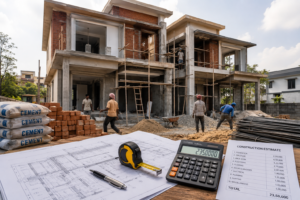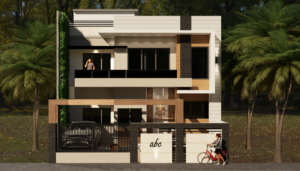
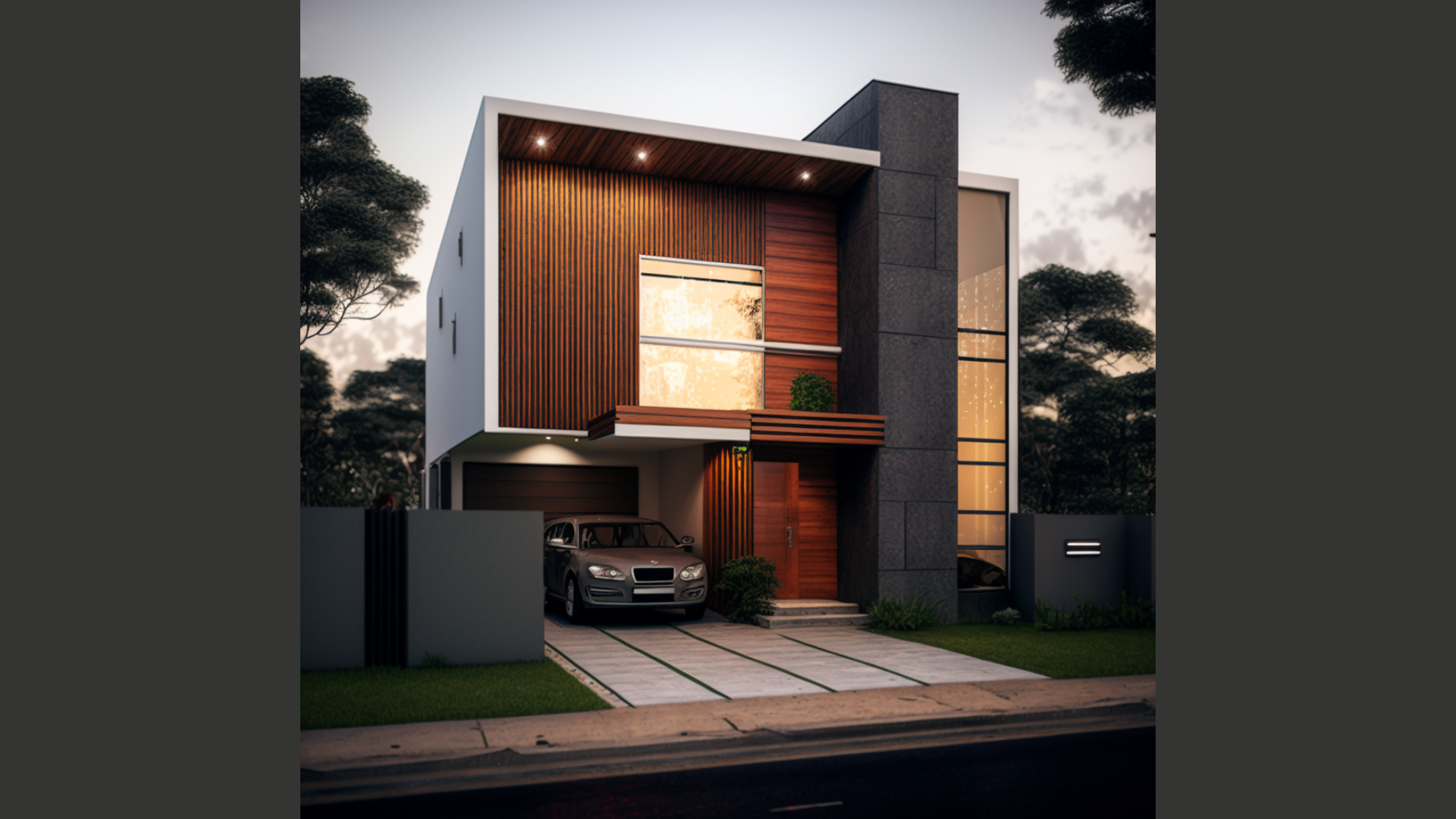
A 20×40 plot measures 800 square feet. Construction cost for this plot size in India generally falls between ₹1,800 and ₹3,500 per square foot depending on the quality of materials, city, labour rates, and finish level. A ground floor house typically costs less than a G+1 structure since additional floors need stronger foundations and structural work. The total project cost also includes approvals, architectural design, interiors, compound wall, and utility connections, which are often left out of basic per square foot quotes.
Table of Contents
ToggleWhat Is the Construction Cost of a 20x40 House in India?
A 20×40 plot gives a total plot area of 800 square feet. The built-up area, which includes wall thickness and covered space, usually works out to around 650 to 700 square feet on the ground floor after setbacks.
Carpet area is the usable floor space inside the walls.
Built-up area includes the carpet area plus wall thickness and balconies.
Super built-up area adds common spaces like staircases and corridors, which mostly applies to apartments rather than independent houses.
For an 800 sq ft plot, most homeowners build either a compact ground floor house, a G+1 structure for rental income or a joint family, or a duplex layout.
| House Type | Approx Built-up Area | Estimated Cost |
|---|---|---|
| Ground Floor | 650 to 700 sq ft | ₹14 lakh to ₹22 lakh |
| G+1 | 1,300 to 1,400 sq ft | ₹26 lakh to ₹42 lakh |
| Duplex | 1,200 to 1,300 sq ft | ₹28 lakh to ₹48 lakh |
These figures are indicative and change based on city and finish level, covered in detail below.
Average 20x40 Construction Cost Per Square Foot in India
20×40 Construction rates in India are usually grouped into four quality tiers. Each tier reflects the materials, finishes, and workmanship used.
| Construction Quality | Cost Per Sq Ft |
|---|---|
| Basic | ₹1,200 to ₹1,800 |
| Standard | ₹1,800 to ₹2,500 |
| Premium | ₹2,500 to ₹3,500 |
| Luxury | ₹3,500 and above |
Basic construction uses standard brand cement, ordinary tiles, and simple fittings. It suits budget builds in tier-2 and tier-3 cities.
Standard construction uses branded TMT steel, vitrified tiles, and mid-range sanitary fittings. This is the most common choice for family homes.
Premium construction includes designer flooring, modular kitchens, false ceilings, and higher-end bathroom fittings.
Luxury construction adds imported materials, home automation, custom woodwork, and architect-led interior design.
Total Cost Breakdown for a 20x40 House
The construction process is divided into distinct work stages, each with its own cost share.
| Work | Estimated Cost |
|---|---|
| Excavation | ₹15,000 to ₹25,000 |
| Foundation | ₹1.2 lakh to ₹2 lakh |
| PCC | ₹20,000 to ₹35,000 |
| RCC Frame | ₹3 lakh to ₹5 lakh |
| Brickwork | ₹1.5 lakh to ₹2.5 lakh |
| Roofing | ₹1.5 lakh to ₹2.2 lakh |
| Waterproofing | ₹30,000 to ₹60,000 |
| Plaster | ₹80,000 to ₹1.3 lakh |
| Flooring | ₹1.2 lakh to ₹2.5 lakh |
| Doors | ₹60,000 to ₹1.2 lakh |
| Windows | ₹50,000 to ₹1 lakh |
| Plumbing | ₹70,000 to ₹1.3 lakh |
| Electrical | ₹80,000 to ₹1.5 lakh |
| Painting | ₹60,000 to ₹1.1 lakh |
| Kitchen | ₹1 lakh to ₹3 lakh |
| Bathrooms | ₹80,000 to ₹1.8 lakh |
| Staircase | ₹40,000 to ₹80,000 |
| External Development | ₹50,000 to ₹1.2 lakh |
For a standard-quality ground floor house on a 20×40 plot, the total generally lands between ₹16 lakh and ₹24 lakh. A G+1 structure roughly doubles the structural cost while sharing the foundation, which brings the per square foot rate down slightly for the upper floor.
20x40 Construction Cost Based on Number of Floors
Ground Floor
A ground floor house on a 20×40 plot suits a small family of three to four members. Construction usually takes four to six months. Cost ranges from ₹14 lakh to ₹22 lakh depending on finish quality.
Ground Plus One Floor
Adding a first floor increases the total cost by 70 to 90 percent rather than doubling it, since the foundation and ground floor structure are already in place. A G+1 house also opens up rental income potential if the upper floor is built as an independent unit. The ground floor foundation must be designed to bear the additional load from the start.
Ground Plus Two Floors
A G+2 structure requires a stronger foundation, additional structural columns, and separate municipal approvals for the extra floor. This option suits larger families or those planning long-term rental income across multiple units. Investment is significantly higher, and structural design needs to account for future loads even if the second floor is built later.
Phase-Wise Construction Cost
Site Preparation
This stage covers clearing the plot, soil testing, excavation, and filling. Soil testing is important on a compact plot like 20×40 since it determines the foundation type needed.
Foundation Cost
Foundation work includes PCC, footings, columns, and the plinth beam. This stage typically accounts for 10 to 12 percent of total construction cost.
Structural Work
RCC work, steel reinforcement, cement, brickwork, and slab casting form the core structural stage. This is usually the single largest cost component, often 35 to 40 percent of the total budget.
Finishing Work
Flooring, wall putty, paint, tiles, POP work, false ceiling, and fixture installation happen at this stage. Finishing quality has the biggest visible impact on final cost per square foot.
Final Installation
The last stage covers electrical fittings, plumbing fixtures, sanitary ware, water tank installation, gate, and compound wall. Many homeowners underestimate this stage, and it often needs a separate budget line.
Material Cost Breakdown
Material cost typically makes up 55 to 65 percent of total construction cost, with the rest going to labour and other charges.
| Material | Approx Share of Budget |
|---|---|
| Cement | 12 to 15 percent |
| Steel | 15 to 18 percent |
| Sand | 8 to 10 percent |
| Aggregate | 5 to 7 percent |
| Bricks | 6 to 8 percent |
| Tiles | 8 to 10 percent |
| Paint | 3 to 5 percent |
| Plumbing | 5 to 7 percent |
| Electrical | 5 to 7 percent |
| Doors | 4 to 6 percent |
| Windows | 3 to 5 percent |
Cement and steel prices fluctuate the most due to changes in fuel cost, transportation, and demand cycles. Buying these materials during stable price periods and locking in bulk quantities can protect the budget from mid-project spikes.
Labour Cost for a 20x40 House
Labour typically accounts for 25 to 35 percent of the total construction budget. Rates vary by trade and city.
| Labour Type | Daily Wage Range |
|---|---|
| Mason | ₹700 to ₹1,200 |
| Carpenter | ₹700 to ₹1,100 |
| Electrician | ₹600 to ₹1,000 |
| Painter | ₹600 to ₹900 |
| Plumber | ₹600 to ₹1,000 |
| Tile worker | ₹700 to ₹1,100 |
Labour contracts cover only workmanship, and the homeowner buys and supplies all materials.
Material contracts or turnkey contracts include both materials and labour under one quoted rate, which is easier to manage but usually costs slightly more overall.
Factors That Affect 20x40 House Construction Cost
Location. Metro cities cost more due to land, labour, and material transport charges.
Soil condition. Rocky or loose soil needs a stronger, costlier foundation.
Number of floors. Each additional floor raises total cost though not linearly.
Structural design. Complex layouts with cantilevers or curves cost more than simple rectangular plans.
Architectural style. Contemporary designs with large glass panels or unique rooflines add to the budget.
Ceiling height. Taller ceilings increase material quantity and cost.
Material quality. Branded materials cost more than local alternatives but often last longer.
Labour charges. Skilled labour in metro areas commands higher wages.
Foundation type. Isolated footings, raft foundations, or pile foundations all carry different costs.
Basement. Adding a basement significantly increases excavation and waterproofing costs.
Parking. Covered parking space adds to both built-up area and material cost.
Balcony. Cantilevered balconies need extra structural reinforcement.
Elevation design. Decorative elevation elements like stone cladding or wooden louvers raise the finishing budget.
Custom furniture. Built-in wardrobes and custom cabinetry add cost beyond standard construction.
Inflation. Material and labour rates rise year on year, generally by 6 to 10 percent annually.
Government taxes. GST on works contracts and other statutory fees add to the final bill.
City-Wise 20x40 House Construction Cost
Construction rates vary meaningfully across Indian cities due to differences in labour cost, material transport, and local building regulations.
| City | Average Cost Per Sq Ft |
|---|---|
| Mumbai | ₹2,800 to ₹4,500 |
| Pune | ₹2,200 to ₹3,500 |
| Delhi | ₹2,500 to ₹4,000 |
| Bengaluru | ₹2,200 to ₹3,800 |
| Hyderabad | ₹2,000 to ₹3,200 |
| Chennai | ₹2,000 to ₹3,200 |
| Ahmedabad | ₹1,800 to ₹2,800 |
| Jaipur | ₹1,700 to ₹2,600 |
| Nagpur | ₹1,700 to ₹2,500 |
| Indore | ₹1,600 to ₹2,400 |
Mumbai and Delhi sit at the higher end due to land scarcity, stricter building codes, and premium contractor margins. Tier-2 cities like Nagpur and Indore offer more affordable rates while still allowing access to quality materials and skilled labour.
Construction Cost According to Finish Level
Budget House
Features include standard cement, ordinary flooring, basic doors and windows, and minimal decorative work. Estimated cost falls between ₹1,200 and ₹1,800 per square foot.
Standard House
Features include branded cement and steel, vitrified tiles, mid-range sanitary fittings, and simple modular kitchen elements. Estimated cost falls between ₹1,800 and ₹2,500 per square foot.
Premium House
Features include designer flooring, false ceiling work, a full modular kitchen, and upgraded bathroom fittings. Estimated cost falls between ₹2,500 and ₹3,500 per square foot.
Luxury House
Features include imported materials, home automation, custom interior design, and premium elevation work. Estimated cost starts at ₹3,500 per square foot and can go significantly higher.
Hidden Costs Most Homeowners Forget
Several expenses fall outside the standard per square foot quote and catch homeowners off guard.
- Architect fees, usually 5 to 10 percent of construction cost
- Structural engineer charges
- Municipal approval and building plan sanction charges
- Soil testing fees
- Borewell drilling cost
- Permanent electricity connection charges
- Permanent water connection charges
- Temporary electricity and water connections during construction
- Compound wall and gate
- Septic tank or sewage connection
- Rainwater harvesting setup, mandatory in several states
- GST on works contracts
- Contingency fund for price escalation
Together, these hidden costs typically add 15 to 20 percent on top of the core construction estimate. Budgeting for them from the start avoids mid-project financial stress.
Sample Budget Calculation
Here is a simplified example for a standard-quality ground floor house on a 20×40 plot.
| Item | Value |
|---|---|
| Plot size | 20×40 (800 sq ft) |
| Built-up area | 680 sq ft |
| Construction rate | ₹2,200 per sq ft |
| Core construction cost | ₹14.96 lakh |
| Hidden costs (18 percent) | ₹2.69 lakh |
| Total estimated cost | ₹17.65 lakh |
Adjusting the construction rate up or down based on city and finish level changes this total proportionally.
Ways to Reduce Construction Cost Without Compromising Quality
Choose a simple rectangular layout, since curves and cantilevers add cost without adding usable space.
Finalize the design before construction starts, since changes mid-project cost far more than planning changes.
Avoid frequent design changes once work begins on a stage.
Compare quotations from multiple contractors before signing an agreement.
Buy major materials like cement and steel in bulk when prices are favorable.
Use locally available materials where they meet quality standards, since this reduces transport cost.
Plan plumbing and electrical layouts carefully before wall construction to avoid rework.
Avoid unnecessary decorative elements that add cost without functional value.
Monitor site progress regularly to catch material wastage or quality issues early.
Set aside a contingency budget of at least 10 percent for unexpected expenses.
Why Good Architectural Planning Saves Money
A well-planned layout uses every square foot efficiently, which reduces the need for a larger built-up area to achieve the same functionality. Efficient planning also lowers structural costs by avoiding unnecessary spans and cantilevers.
Better ventilation and natural lighting design reduce long-term electricity costs. Thoughtful planning also reduces material wastage during construction and lowers the chance of costly errors that need rework.
A house designed with future expansion in mind, such as a G+1 addition, avoids expensive structural retrofitting later. All of this adds up to lower maintenance costs over the life of the house.
Why Choose SmartScale House Design for Your Home Project
SmartScale House Design offers customized 20×40 house plans built around your budget and lifestyle. Services include architectural and structural drawings, 3D elevation designs, and Vastu-compliant layouts where required.
The team provides online design services across India, along with accurate material and cost planning tailored to your specific plot and requirements. Space-efficient solutions work well for small and medium plots like 20×40, and ongoing support continues through the construction phase.
Planning to build a home on a 20×40 plot? SmartScale House Design provides customized house plans, structural drawings, 3D elevations, and construction-ready designs tailored to your budget and lifestyle. Start with a professionally designed plan to reduce costly mistakes and make the most of your available space.