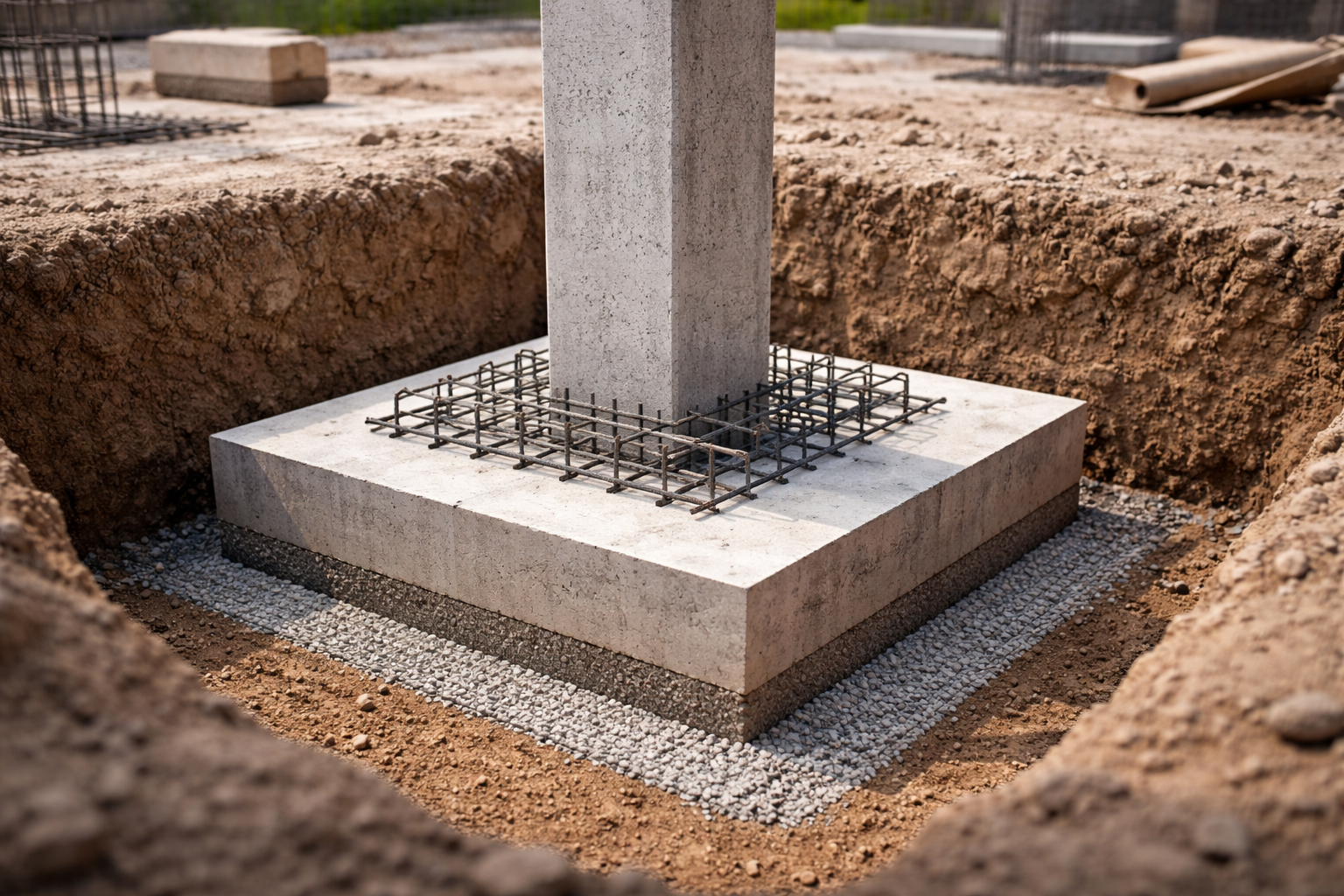
What is isolated footing? Isolated footing is a shallow foundation type used to support a single column. It transfers the load from the column directly to the soil below.
Isolated footing formula: Footing Area = Total Load / Safe Bearing Capacity of Soil
Types of isolated footing: Pad footing, sloped footing, and stepped footing.
When is isolated footing used? When columns are spaced far apart and the soil has adequate load-bearing capacity.
Introduction
Foundation design is the most critical part of any construction project. A wrong foundation choice can lead to settlement, cracks, and even structural failure. Yet it is one of the most overlooked aspects in residential construction.
Isolated footing is the most commonly used foundation type in India for small to medium residential buildings. It is simple, cost-effective, and easy to construct when the site conditions are suitable.
This guide covers everything you need to know about isolated footing, including its definition, types, step-by-step design process, formula, plan details, advantages, disadvantages, and when to use it.
What is Isolated Footing?
Isolated footing is a type of shallow foundation that supports one single column independently. Each column gets its own footing, which is why it is called “isolated.”
The load transfer path is straightforward:
Column → Footing Slab → Soil
The footing spreads the concentrated load from the column over a larger area of soil. This reduces the pressure on the soil so it stays within safe limits.
Simple Example: If a column carries 100 kN of load and the soil can safely handle 200 kN/m², the footing needs at least 0.5 m² of base area to distribute the load safely.
Isolated footings are most common in individual houses, small commercial buildings, and low-rise structures where columns are spaced apart and the soil is reasonably strong.
Where is Isolated Footing Used?
Isolated footing works well in specific conditions. Understanding where to use it helps avoid costly mistakes.
Residential Buildings Most ground-plus-two or ground-plus-three floor homes in India use isolated footings. The loads are manageable and soil conditions in many urban and semi-urban areas support this foundation type.
Low-Rise Structures Buildings up to four or five floors typically fall within the load range that isolated footings can handle comfortably.
Good Soil Conditions Sites where soil has a safe bearing capacity of 150 kN/m² or above are suitable for isolated footings. Hard murrum, medium hard soil, and rocky strata work well.
Columns Spaced Far Apart When columns are placed at a standard spacing of 3 to 5 meters, isolated footings work independently without overlapping. If columns are too close, combined footing is the better choice.
Isolated Footing Details
Understanding the components and specifications of an isolated footing helps during both design and supervision.
Main Components
Column The vertical structural member that carries loads from beams and slabs down to the footing.
PCC Layer (Plain Cement Concrete) A leveling course placed at the bottom of the excavation before the footing is cast. Typically 75mm to 100mm thick with M10 grade concrete.
Footing Slab The main reinforced concrete slab that spreads the load. This is the core structural element of the isolated footing.
Reinforcement Bars Steel bars placed in a grid pattern at the bottom of the footing slab. They resist bending and tensile forces that the concrete alone cannot handle.
Column Starter Bars Bars that project upward from the footing to connect with the column reinforcement above.
Typical Specifications
| Component | Typical Value |
|---|---|
| Footing depth | 900mm to 1800mm below ground |
| Footing slab thickness | 150mm to 450mm |
| Concrete grade | M20 or higher |
| PCC thickness | 75mm to 100mm |
| Cover to reinforcement | 50mm minimum |
The actual specifications depend on the load, soil conditions, and structural design. Always follow the design prepared by a qualified structural engineer.
Types of Isolated Footing
There are three main types of isolated footing. Each type suits different load conditions and site situations.
Pad Footing
Pad footing is the simplest and most common type. It is a flat rectangular or square slab of uniform thickness placed under the column.
Key Features:
- Uniform thickness throughout
- Easy to design and construct
- Most cost-effective option
- Suitable for light to moderate column loads
Pad footings are the standard choice for most residential buildings in India. The construction process is straightforward and requires no special formwork.
Sloped Footing
Sloped footing has a flat base but the top surface slopes upward toward the column. The thickness is maximum at the column face and reduces toward the edges.
Key Features:
- Reduces concrete volume compared to pad footing
- Better load distribution in some cases
- Slightly more complex formwork required
- Saves material cost in larger footings
Sloped footings are preferred when the footing size is large and saving on concrete volume matters. They are structurally efficient because more material is concentrated where the bending stress is highest.
Stepped Footing
Stepped footing has a series of steps from a wider base to the column. Each step is a flat slab, and the overall shape looks like a pyramid from the side.
Key Features:
- Handles heavy column loads
- Suitable when excavation depth varies across the site
- More formwork and labor involved
- Used in multi-story commercial buildings
Stepped footings are less common in residential construction but are used in industrial buildings and structures with heavy column loads.
Isolated Footing Plan
An isolated footing plan is a drawing that shows the layout, size, and reinforcement details of all footings in a building. It is prepared by a structural engineer before construction begins.
What a Footing Plan Includes
Column Layout The plan shows the position of each column on the grid. Each column is labeled (C1, C2, C3 etc.) and the footing for each column is shown.
Footing Size and Dimensions Each footing is drawn with its length, width, and depth clearly marked. Different columns may have different footing sizes based on the load they carry.
Reinforcement Details The plan and section drawings show the bar diameter, spacing, number of bars, and arrangement. Both top and bottom reinforcement layers are shown if applicable.
PCC and Excavation Details The section view shows the PCC layer thickness, excavation depth, and soil profile.
Why Planning Before Construction Matters
Starting construction without a proper footing plan leads to problems like wrong footing sizes, inadequate reinforcement, misaligned columns, and unnecessary cost overruns. A proper plan takes time upfront but saves significant money and rework during construction.
Isolated Footing Design: Step by Step
Designing an isolated footing involves calculating loads, checking soil capacity, and determining the footing size and reinforcement. Here is the complete process.
Step One: Calculate the Total Load on the Column
The total load includes:
Dead Load: Weight of the structure itself. Beams, slabs, walls, columns, and the footing weight are all part of dead load.
Live Load: Load from occupants, furniture, stored materials, and other variable sources. IS 875 Part 2 gives standard live load values for different building types.
Self Weight of Footing: An additional 10% to 15% of the column load is usually added to account for the footing and soil weight above it.
Total Load Example: Dead load = 400 kN Live load = 150 kN Self weight addition (10%) = 55 kN Total = 605 kN
Step Two: Get the Safe Bearing Capacity of Soil
SBC is determined from a soil investigation report. A geotechnical engineer conducts soil tests and provides the safe bearing capacity value in kN/m².
Typical SBC Values:
| Soil Type | Approximate SBC |
|---|---|
| Soft clay | 50 to 100 kN/m² |
| Medium clay | 100 to 150 kN/m² |
| Dense sand | 200 to 300 kN/m² |
| Hard murrum | 250 to 350 kN/m² |
| Rock | 500 kN/m² and above |
Never assume SBC without a proper soil test. This is one of the most common and dangerous mistakes in foundation design.
Step Three: Calculate the Required Footing Area
Use the basic isolated footing formula:
Footing Area = Total Load / Safe Bearing Capacity
Example: Total Load = 605 kN SBC = 200 kN/m² Required Area = 605 / 200 = 3.025 m²
Step Four: Decide the Footing Size
For a square footing: Side = Square root of Area = Square root of 3.025 = approximately 1.75m
So the footing size would be 1.75m x 1.75m.
For rectangular footings, the dimensions are adjusted based on space availability and structural requirements.
Always round up to the nearest practical dimension and recheck.
Step Five: Design the Reinforcement
Reinforcement is designed to resist bending moments and shear forces in the footing slab.
Key Design Checks:
- Bending moment at the column face
- One-way shear (beam shear)
- Two-way shear (punching shear)
- Minimum reinforcement as per IS 456
Steel bars are placed in a grid pattern in both directions. Typical bar diameters range from 10mm to 16mm with spacing of 100mm to 200mm depending on the design.
Step Six: Check Shear Capacity
Two types of shear must be checked:
One-Way Shear: Treated like a beam. The critical section is at a distance equal to the effective depth from the column face.
Two-Way Shear (Punching Shear): The footing may punch around the column perimeter. The critical perimeter is checked at d/2 from the column face on all sides.
If the concrete section fails in shear, the footing thickness is increased. Shear reinforcement is generally avoided in footings by increasing thickness instead.
Isolated Footing Formula
The core formula is simple but must be applied correctly with all loads included.
Basic Formula
Footing Area (A) = Total Load (P) / Safe Bearing Capacity (q)
Extended Formula for Design
Net upward soil pressure (q_net) = P / A
Bending Moment at column face = q_net x (L x B²/2)
where L is the footing length and B is the projection beyond the column face.
Complete Example Calculation
Given Data: Column size: 300mm x 300mm Dead load: 400 kN Live load: 150 kN SBC of soil: 200 kN/m² Concrete grade: M20 Steel grade: Fe415
Step 1: Total load = 400 + 150 = 550 kN Add 10% for self weight = 550 x 1.10 = 605 kN
Step 2: Required area = 605 / 200 = 3.025 m²
Step 3: For square footing, side = √3.025 = 1.74m, adopt 1.75m x 1.75m
Step 4: Net upward pressure = 550 / (1.75 x 1.75) = 179.6 kN/m²
Step 5: Projection beyond column = (1750 – 300) / 2 = 725mm = 0.725m
Step 6: Bending moment = 179.6 x 1.75 x 0.725² / 2 = 82.7 kNm
This moment is then used to calculate the required steel reinforcement area using standard IS 456 design equations.
Isolated Footing Drawing and Plan Explanation
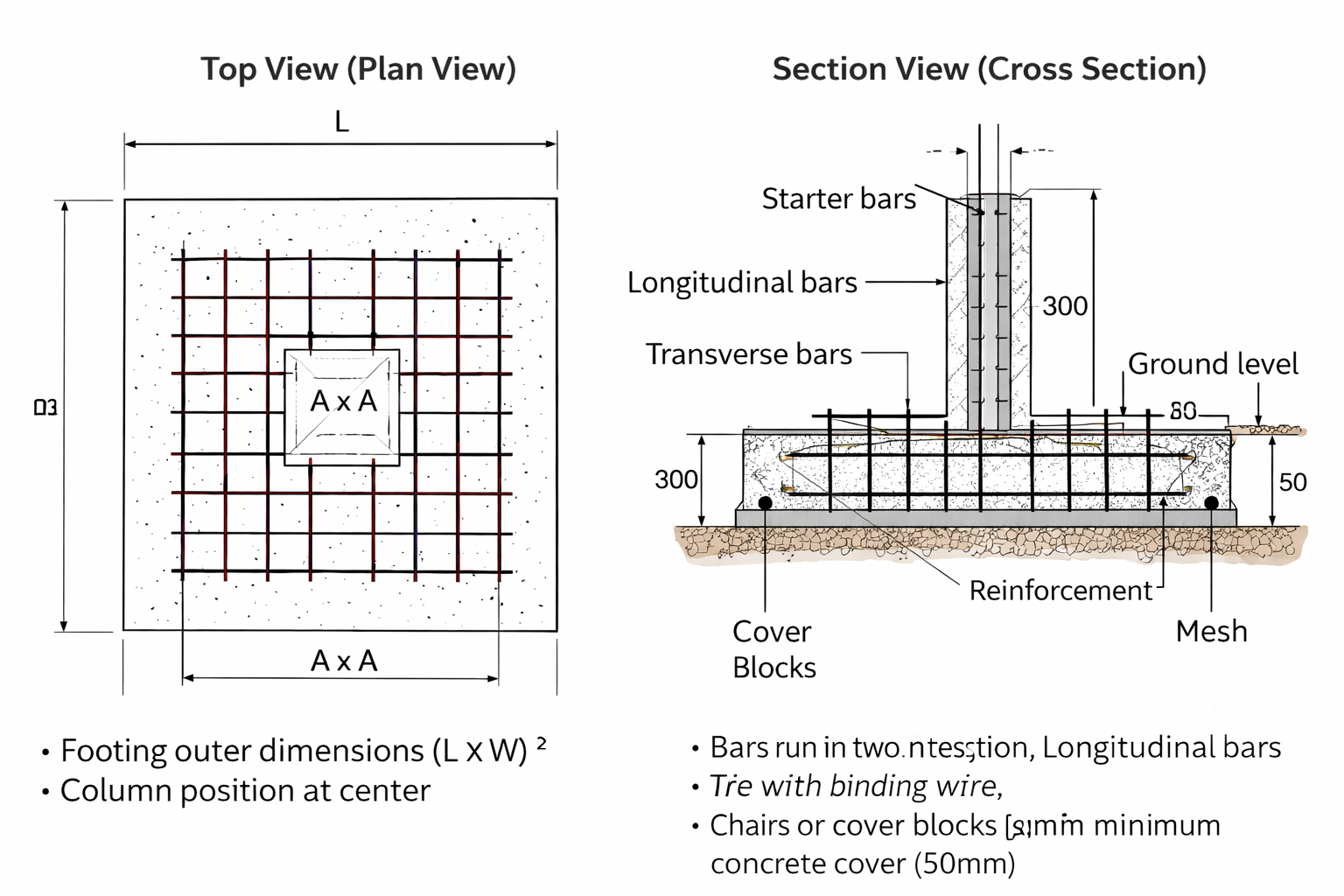
A proper footing drawing includes two main views:
Top View (Plan View)
Shows the footing as seen from above. You can see:
- Footing outer dimensions (length x width)
- Column position at center
- Reinforcement bar layout as a grid
- Bar spacing and direction labels
Section View (Cross Section)
Shows the footing cut vertically. You can see:
- PCC layer at the bottom
- Footing slab thickness
- Reinforcement bars with cover dimensions
- Column starter bars projecting upward
- Ground level and excavation depth
Reinforcement Layout
Bars run in two directions, longitudinal and transverse, forming a mesh. The bars are tied at intersections using binding wire. Chairs or cover blocks are placed under the bars to maintain the correct concrete cover of 50mm minimum.
Advantages of Isolated Footing
Isolated footing is the most popular foundation type for residential buildings in India for good reasons.
Cost-Effective Less concrete and steel is used compared to raft or combined footings. Excavation is also limited to individual column locations rather than the entire building footprint.
Simple Construction No complex formwork or special construction techniques are needed. Any competent local contractor can construct isolated footings correctly.
Less Excavation Only the area under each column is excavated. This reduces earthwork cost and time significantly compared to raft foundations.
Faster Construction Individual footings can be cast one at a time or in batches. This gives flexibility in construction scheduling.
Ideal for Good Soil Sites When the soil is firm and has adequate bearing capacity, isolated footing uses the soil strength efficiently.
Disadvantages of Isolated Footing
Isolated footing is not suitable for every situation. Knowing its limitations helps make the right foundation choice.
Not Suitable for Weak Soil If the SBC is below 100 kN/m², the required footing area becomes very large. At some point, the footings may overlap, making isolated footing impractical.
Differential Settlement Risk When soil conditions vary across the site, different footings may settle by different amounts. This differential settlement causes cracks in walls and beams.
Not Ideal for Closely Spaced Columns When columns are close together (less than 2m apart), footings may overlap. Combined footing or raft footing is the better option in such cases.
Limited Load Capacity For heavily loaded columns in multi-story buildings, isolated footings become very large and may not be structurally efficient.
Isolated Footing vs Combined Footing
| Feature | Isolated Footing | Combined Footing |
|---|---|---|
| Columns supported | One column per footing | Two or more columns |
| Cost | Lower | Higher |
| Construction complexity | Simple | Moderate |
| Best use case | Columns spaced apart | Closely spaced columns |
| Soil condition | Good bearing capacity | Weak or variable soil |
| Excavation | Limited | More extensive |
| Differential settlement control | Lower | Better |
When to Choose Isolated Footing Over Combined Footing: Choose isolated footing when columns are at least 3m apart, soil is uniform and strong, and the building is low-rise with moderate loads.
When to Choose Combined Footing: Choose combined footing when two columns are very close together, one column is near a property boundary, or soil conditions vary significantly.
When to Choose Isolated Footing
Use isolated footing when all of the following conditions are met:
Strong Soil SBC is 150 kN/m² or above based on a soil test report.
Well-Spaced Columns Columns are spaced at 3 meters or more in both directions so footings do not overlap.
Low to Medium Building Height Structure is ground plus two or ground plus three floors with moderate column loads.
Limited Budget Isolated footing is the most economical option when site conditions permit its use.
Uniform Soil Profile Soil conditions are consistent across the building site to avoid differential settlement.
Common Mistakes to Avoid
Many construction problems in residential buildings trace back to foundation errors. Here are the most frequent mistakes:
Skipping the Soil Test Assuming SBC without testing is the most dangerous mistake. Soil can vary dramatically even within a single plot. Always get a soil investigation done before designing the foundation.
Incorrect Reinforcement Placement Bars placed at wrong spacing, wrong cover, or wrong direction reduce the footing’s load capacity. Always follow the structural drawing exactly.
Poor Curing Concrete gains strength only when properly cured for at least 7 days. Skipping or reducing curing time leads to weak concrete that may crack under load.
Wrong Footing Size Undersized footings lead to excessive soil pressure and settlement. Oversized footings waste money. Use the correct formula with accurate load data.
No PCC Layer Pouring the footing directly on soil without PCC leads to contamination of concrete and difficulty in maintaining correct cover.
Premature Loading Loading the footing before concrete reaches adequate strength (at least 28 days for full design strength) can cause damage that is not immediately visible.
Cost of Isolated Footing in India
The cost of constructing an isolated footing in India depends on multiple factors. Here are approximate figures as of 2024-25.
Cost Per Footing (Approximate):
| Footing Size | Approximate Cost |
|---|---|
| 1m x 1m | Rs. 8,000 to Rs. 12,000 |
| 1.5m x 1.5m | Rs. 15,000 to Rs. 22,000 |
| 2m x 2m | Rs. 25,000 to Rs. 38,000 |
These are indicative figures. Actual costs vary based on city, material prices, labor rates, and depth of excavation.
Factors Affecting Cost:
Soil Condition: Hard rock excavation costs more than soft soil digging. Deep water table also increases cost.
Material Prices: Steel and cement prices vary by region and season. Buying materials during off-season can reduce costs.
Concrete Grade: Using M25 instead of M20 increases material cost but provides better durability.
Depth of Footing: Deeper foundations need more concrete, more excavation, and more labor.
Labor Rates: Metro cities have higher labor costs than tier-2 and tier-3 cities.
Conclusion
Isolated footing is the most practical and economical foundation choice for residential buildings in India when the soil and structural conditions are right. It is straightforward to design, easy to construct, and cost-effective for low to medium rise structures.
The key to a successful isolated footing design is accurate load calculation, a proper soil test, and correct reinforcement detailing. Skipping any of these steps creates risks that may not be visible immediately but can lead to serious structural problems over time.
Always work with a qualified structural engineer for foundation design. A properly designed and constructed foundation protects your investment for the lifetime of the building.
Design Your Foundation Right with SmartScale House Design
Building a strong house starts from the foundation and a small mistake here can lead to big problems later. Instead of guessing sizes or copying generic plans, get your footing designed based on your soil condition, load requirements, and budget.
With SmartScale House Design, you get:
- Custom isolated footing design tailored to your plot
- Structural safety with expert-approved calculations
- Detailed drawings (plan + section + reinforcement layout)
- Cost-optimized solutions to avoid overspending
- Complete support from foundation to final house plan