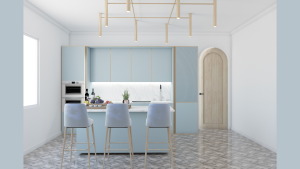
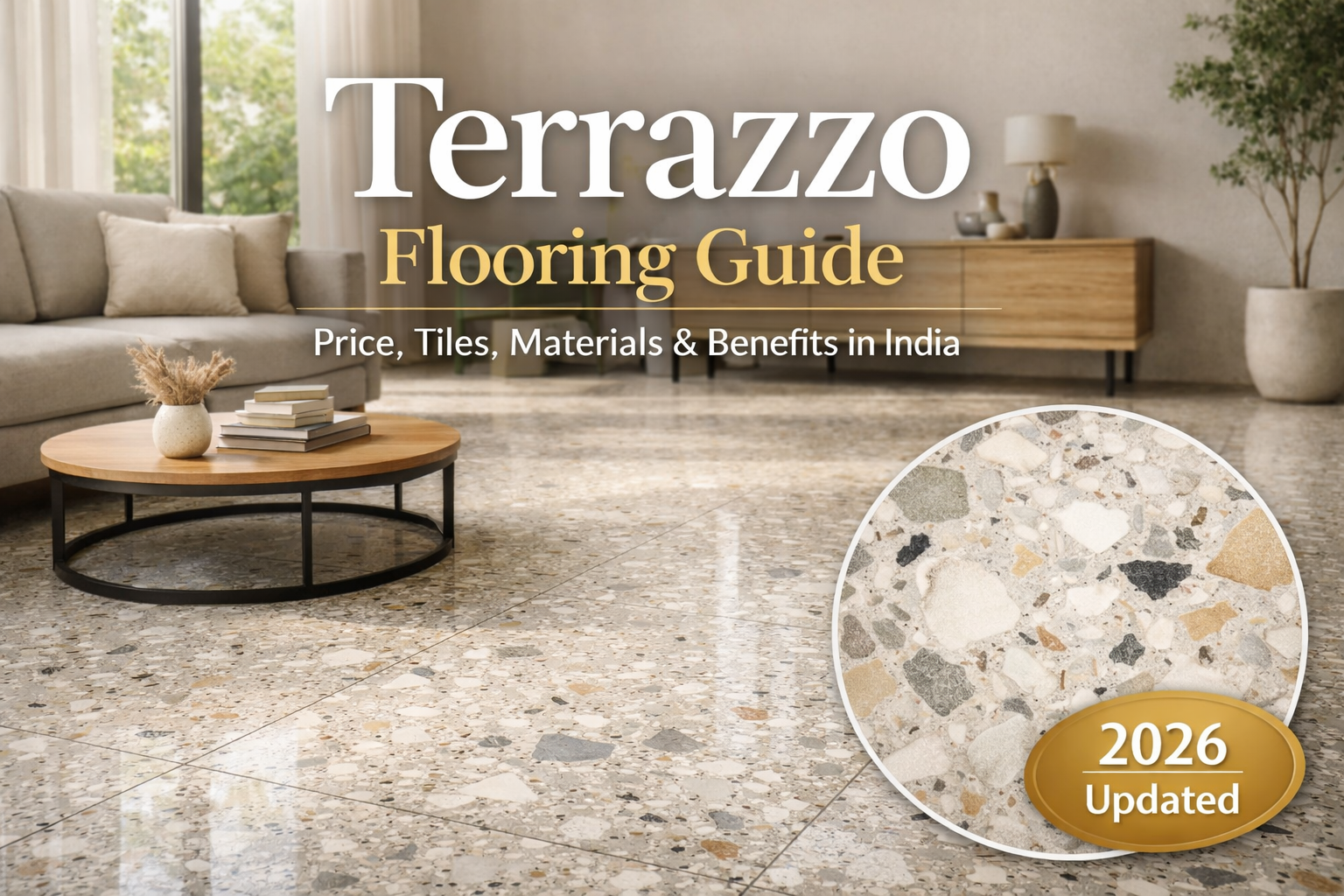
Terrazzo flooring is a durable and stylish flooring option made from marble, quartz, or glass chips embedded in cement or epoxy. In India, terrazzo flooring price typically ranges from ₹80 to ₹600 per sq ft depending on the type, design, and materials used. Terrazzo flooring tiles are also available, with prices starting from ₹40 per sq ft. It is widely used in modern homes due to its long lifespan, low maintenance, and customizable designs.
Table of Contents
ToggleWhat is Terrazzo Flooring?
Terrazzo flooring is a composite surface made by embedding chips of marble, quartz, glass, or granite into a binder, typically cement or epoxy, and then grinding and polishing the surface to a smooth finish.
The word “terrazzo” comes from Italian and means “terrace.” It was originally developed in Venice over 500 years ago when workers recycled marble offcuts into affordable floors. Today, the process is far more refined, but the core concept remains the same.
Composition at a glance:
- Aggregate chips: marble, quartz, glass, or recycled materials
- Binder: cement (traditional) or epoxy (modern)
- Pigments for color customization
- Sealers and polishing compounds for the final finish
Modern terrazzo has moved beyond its utilitarian roots. It now comes in bold patterns, custom color palettes, and both poured-in-place and precast tile formats. This flexibility is exactly why it is trending in Indian homes and commercial spaces right now.
Terrazzo Flooring in India: Market Overview
Terrazzo has seen a sharp revival in India over the past five years. What was once associated with old government buildings and airports is now appearing in luxury apartments, boutique hotels, and contemporary retail spaces.
Why is terrazzo growing in India?
The push toward sustainable interiors is one reason. Terrazzo uses recycled chip materials, which aligns with eco-conscious design trends. Architects also appreciate that it can be customized to match any interior palette, from soft pastels to bold geometric patterns.
Residential demand is growing in metro cities like Mumbai, Bengaluru, Hyderabad, and Delhi. Commercial spaces, including offices, showrooms, and hospitality venues, are the biggest buyers of epoxy terrazzo due to its seamless, premium look.
Terrazzo tiles are particularly popular in mid-segment housing projects because they offer the terrazzo aesthetic at a lower cost compared to poured-in-place options.
Types of Terrazzo Flooring
Cement-Based Terrazzo
Cement terrazzo is the traditional form. A layer of cement mixed with marble or stone chips is poured directly onto the floor, allowed to cure, and then ground and polished.
It is affordable, durable, and well-suited for residential use. The main limitation is that it requires skilled on-site labor and takes longer to install than tiles. It is also more porous than epoxy and needs proper sealing.
Best for: bedrooms, living rooms, and corridors in homes and schools.
Epoxy Terrazzo
Epoxy terrazzo uses a two-part epoxy resin as the binder instead of cement. The result is a thinner, stronger, and more visually vibrant surface with far lower porosity.
It offers a glossy, seamless finish that is ideal for large commercial spaces. Epoxy allows for more intricate designs and brighter color chips because it does not shrink or crack the way cement does. It is, however, significantly more expensive.
Best for: hotels, malls, offices, and high-end residential interiors.
Terrazzo Flooring Tiles
Terrazzo tiles are factory-manufactured in controlled settings and come in standard sizes, typically 300×300 mm, 400×400 mm, and 600×600 mm. They are easier to install, require less skilled labor, and are more cost-effective.
Precast tiles are ideal for renovation projects where poured-in-place installation is not practical. They are available in a wide range of designs, from classic speckled looks to bold, graphic patterns.
Best for: bathrooms, kitchens, balconies, and affordable housing projects.
Terrazzo Flooring Tiles: Designs and Styles
Terrazzo tiles come in a broad spectrum of designs. Here is what is currently trending in the Indian market:
Popular design styles:
- Classic speckled: Small marble chips on a white or grey base
- Geometric patterns: Hexagonal tile layouts with contrasting grout
- Bold color blocking: Bright colored chips on a dark base
- Terrazzo Zellige-inspired: Irregular chips in earthy, warm tones
- Glass chip terrazzo: High shine, reflective finish for modern interiors
Chip materials used:
- White, grey, or colored marble chips for a timeless look
- Quartz chips for added durability and sparkle
- Recycled glass chips for eco-friendly and luminous designs
- Mother of pearl chips for premium, luxury applications
- Finish options:
- Polished finish: High gloss, reflects light, best for formal spaces
- Matte finish: Soft, understated look, suited for bedrooms and cafes
- Honed finish: Flat, smooth, mid-sheen, versatile for most interiors
Terrazzo Flooring Materials
Understanding what goes into terrazzo helps you make better purchasing decisions.
Primary binder: Cement is used for traditional terrazzo. It is affordable and widely available but has higher porosity and requires sealing. Epoxy resin is used for modern terrazzo. It is more durable, water-resistant, and allows for finer chip distribution and more vibrant colors.
Aggregate chips: Marble is the most common chip material. Quartz, granite, shell, mirror, and recycled glass are also used. The chip size, density, and color mix largely determine the final look.
Pigments: Inorganic oxide pigments are mixed into the binder to achieve custom background colors. These are light-stable and do not fade over time, even with heavy sunlight exposure.
Sealers: Both cement and epoxy terrazzo require topcoat sealers to resist staining, moisture penetration, and daily wear. Penetrating sealers are used for cement terrazzo, while surface sealers or wax topcoats are used for epoxy.
Eco-friendly options: Many modern terrazzo products use recycled glass, reclaimed marble dust, and low-VOC epoxy binders. This makes terrazzo one of the more sustainable flooring options available in India today.
Terrazzo Flooring Price in India (2026 Guide)
Terrazzo Flooring Price per Sq Ft
| Type | Price Range |
|---|---|
| Cement terrazzo (poured) | ₹80 to ₹150 per sq ft |
| Epoxy terrazzo (poured) | ₹250 to ₹600 per sq ft |
These rates typically include materials and labor. Epoxy terrazzo costs more due to material cost, longer cure time, and the need for specialized applicators.
Terrazzo Flooring Tiles Price
| Tile Type | Price Range |
|---|---|
| Basic cement tiles | ₹40 to ₹100 per sq ft |
| Mid-range patterned tiles | ₹100 to ₹200 per sq ft |
| Premium designer tiles | ₹200 to ₹300 per sq ft |
Tiles are generally more affordable than poured terrazzo and are easier to install, which keeps labor costs lower.
Factors Affecting Terrazzo Flooring Price
Material quality: Epoxy is costlier than cement. Premium chip materials like mother of pearl or custom glass drive up the price.
Labor charges: Poured-in-place terrazzo requires skilled masons and polishing equipment. Labor can account for 40 to 60 percent of the total cost in India.
Design complexity: Simple speckle patterns cost less. Custom logos, intricate borders, or multi-color inlays significantly increase the price.
Location: Material and labor costs vary across cities. Mumbai, Delhi, and Bengaluru tend to be 15 to 25 percent more expensive than Tier-2 cities.
Floor size: Larger areas benefit from economies of scale. Per-sq-ft cost typically drops for projects above 500 sq ft.
Terrazzo Flooring vs Mosaic Flooring
| Feature | Terrazzo Flooring | Mosaic Flooring |
|---|---|---|
| Finish | Smooth and polished | Slightly textured |
| Cost | Medium to high | Low to medium |
| Durability | Very high | High |
| Look | Modern and seamless | Traditional and patterned |
| Maintenance | Low | Moderate (grout lines) |
| Installation | Skilled labor required | Relatively easier |
| Customization | Very high | Moderate |
Key differences:
Terrazzo is poured or tiled as a unified surface. Mosaic uses small individual tiles set in patterns, which means grout lines are visible and require regular cleaning. Terrazzo has no visible joints in poured format, giving it a cleaner, more contemporary look.
Which is better for Indian homes?
Terrazzo is better for modern interiors, large floor areas, and long-term value. Mosaic is better for decorative feature walls, bathrooms with smaller budgets, and areas where a traditional aesthetic is preferred. If low maintenance and longevity are priorities, terrazzo wins.
Terrazzo Flooring by Kajaria Ceramics
Kajaria Ceramics is one of India’s largest tile manufacturers and offers a range of terrazzo-look and terrazzo-effect tiles as part of their flooring collection.
What Kajaria offers:
Kajaria’s terrazzo range includes vitrified and ceramic tiles with printed terrazzo patterns. These are not true aggregate terrazzo but offer a similar visual effect at a lower cost and with easier installation.
Their terrazzo-look tiles typically come in large formats such as 600×600 mm and 800×800 mm, with both polished and matte surface finishes.
Price range:
Kajaria terrazzo-look tiles are generally priced between ₹60 and ₹180 per sq ft, making them accessible for mid-segment residential projects.
Durability and quality:
As a reputed Indian brand, Kajaria tiles carry BIS certification and are tested for abrasion resistance and water absorption. While they do not offer the depth or customization of real terrazzo, they are a practical and affordable alternative.
If you want the terrazzo aesthetic without the installation complexity or cost, Kajaria tiles are a solid option.
Benefits of Terrazzo Flooring
Long-lasting durability: Terrazzo floors can last 40 to 50 years or more with proper maintenance. It is one of the few flooring materials that gets better with time as polishing restores its shine.
Low maintenance: Daily sweeping and occasional mopping with a neutral cleaner is all terrazzo needs. It does not trap dust or allergens in grout lines like other tile formats.
Eco-friendly: Terrazzo uses recycled marble chips, glass offcuts, and low-impact binders. It has a long lifespan, which reduces the frequency of replacement and associated waste.
Highly customizable: From chip color and size to background pigment and pattern layout, terrazzo can be tailored to any design vision. This makes it suitable for both minimalist and bold interior styles.
Seamless finish: Poured terrazzo has no visible joints or seams. This makes large floors look expansive and is also more hygienic, as there are no grout lines to collect bacteria.
Cost-effective in the long run: The higher upfront cost is offset by negligible repair expenses and an exceptionally long service life. Compared to flooring that needs replacement every 10 to 15 years, terrazzo offers better value over time.
Heat resistant: Terrazzo stays cool underfoot even in hot weather, making it well-suited for the Indian climate. It is comfortable to walk on during summer months without footwear.
Disadvantages of Terrazzo Flooring
Higher initial cost: Poured terrazzo, especially epoxy, involves significant material and labor costs. For tight budgets, it may not be the first choice.
Time-consuming installation: Poured terrazzo requires multiple stages: base preparation, pouring, curing, grinding, and polishing. This process can take several days to complete, which disrupts ongoing construction schedules.
Needs skilled labor: Terrazzo installation is not a DIY job. Poor workmanship leads to cracks, uneven polish, or improper sealing. Finding experienced terrazzo contractors in smaller cities can be difficult.
Can be slippery when wet: Polished terrazzo has a smooth surface that can become slippery if water is not wiped quickly. Matte finishes or anti-slip sealers are recommended for bathrooms and outdoor areas.
Where Can You Use Terrazzo Flooring?
Living room: Terrazzo creates a statement floor in living and dining areas. Large, seamless poured terrazzo with bold chip patterns is popular in open-plan homes.
Kitchen: It is heat-resistant and easy to clean, making it practical for kitchen floors. Matte-finish terrazzo tiles work well here.
Bathroom: Terrazzo tiles are a popular choice for bathroom floors and walls. Use textured or matte finishes to prevent slipping.
Commercial spaces: Offices, hotels, cafes, showrooms, and retail stores use epoxy terrazzo for its durability and visual impact. It handles heavy foot traffic exceptionally well.
Balconies and corridors: Cement terrazzo tiles are commonly used in corridors, balconies, and stairways in residential complexes.
Installation Process of Terrazzo Flooring
Surface preparation: The subfloor is leveled, cleaned, and any cracks are filled. For epoxy terrazzo, moisture testing is done to ensure the substrate is dry, since moisture can compromise epoxy bonding.
Material mixing: For poured terrazzo, the binder (cement or epoxy) is mixed with pigment and aggregate chips in measured ratios. Consistency in mixing is essential for an even finish.
Pouring and curing: The mixture is poured and spread evenly across the floor. Divider strips made of brass, zinc, or aluminum are used to create pattern sections and also prevent cracking. Cement terrazzo takes 24 to 48 hours to set; epoxy cures faster but requires temperature control.
Grinding and polishing: After curing, the floor is ground using a series of diamond-grit grinding machines, starting with coarser grits and progressing to finer ones. This reveals the aggregate chips and creates the characteristic terrazzo surface. The floor is then cleaned, grouted, and polished.
Sealing: A penetrating or surface sealer is applied as the final step to protect against staining and moisture.
Maintenance Tips for Terrazzo Flooring
Regular cleaning: Sweep or vacuum daily to remove dust and grit that can scratch the surface. Mop with a neutral pH cleaner and warm water. Avoid soap-based cleaners as they leave a residue that dulls the surface.
Avoid harsh chemicals: Do not use acidic cleaners, bleach, or vinegar on terrazzo. Acid reacts with the marble chips and cement binder, causing etching and permanent dull patches.
Periodic polishing: Poured terrazzo benefits from professional re-polishing every three to five years, depending on foot traffic. This restores its original gloss and removes surface scratches.
Sealing for longevity: Re-seal cement terrazzo every one to two years to maintain stain resistance. Epoxy terrazzo needs less frequent sealing but benefits from a fresh topcoat after heavy use.
Address spills immediately: Liquids like coffee, wine, and turmeric can stain if left to sit. Wipe spills promptly.
Is Terrazzo Flooring Worth It in India?
Cost vs. durability: The upfront cost is higher than options like vitrified tiles or laminate. However, a well-installed terrazzo floor lasts 40 to 50 years with minimal repair costs. This makes the total cost of ownership lower than most alternatives.
Long-term investment: For homeowners who plan to stay in their property for the long term, terrazzo is a sound investment. It adds perceived value to the property and holds its aesthetic appeal far longer than trend-driven flooring options.
Best use cases: Terrazzo is ideal for homes and spaces where durability, hygiene, and design quality are priorities. It is not the best choice for rental properties on tight renovation budgets or for quick-turnaround construction projects where installation timelines are critical.
The short answer: yes, terrazzo is worth it if you are building or renovating a property you intend to use for a decade or more.
Conclusion
Terrazzo flooring combines long-term durability with a high design ceiling that few other flooring types can match. In India, it is available across a wide price range, from affordable cement tiles at ₹40 per sq ft to premium epoxy installations at ₹600 per sq ft or more.
Whether you choose poured cement terrazzo for a budget-conscious renovation, epoxy terrazzo for a luxury interior, or Kajaria terrazzo tiles for a quick and cost-effective upgrade, terrazzo delivers strong value at every price point.
For most Indian homeowners and developers, terrazzo is a smart, future-proof flooring choice.
Plan Your Home with SmartScale House Design
Planning your dream home with modern terrazzo flooring? Get custom house plans, 3D elevation designs, and expert guidance from SmartScale House Design today. Our team helps you select the right flooring, materials, and finishes to match your vision, budget, and lifestyle.